Why Your Body Uses Tension to Feel Strong
Why Your Body Uses Tension to Feel Strong
When people want to feel stronger, they often do one thing automatically.
They tense.
They brace the stomach.
Tighten the shoulders.
Clench the jaw.
Grip the floor.
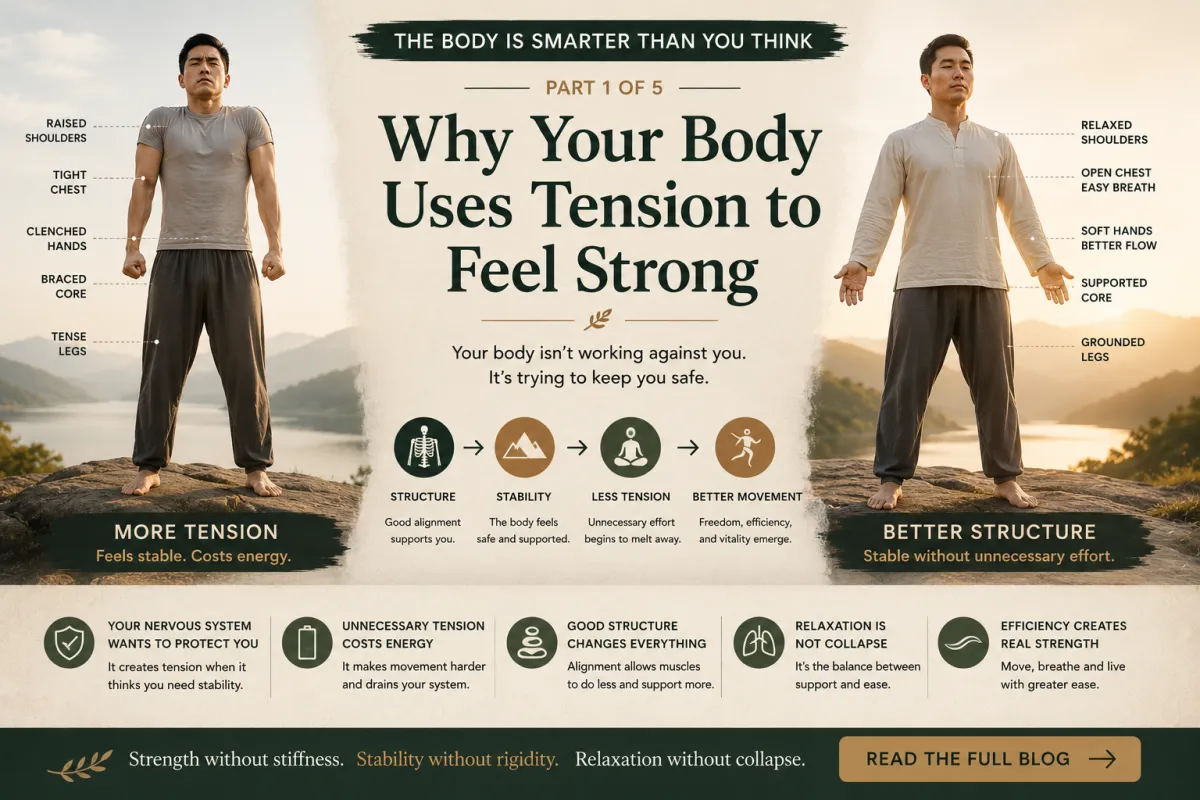
More tension feels like more strength.
But tension and strength aren't the same thing.
Imagine driving a car with the handbrake slightly engaged.
The engine can still produce plenty of power.
But some of that power is being wasted fighting against the car itself.
The human body can do something similar.
Your Body Loves Stability
Your nervous system has an important job:
Keep you upright and keep you safe.
When it isn't confident about a movement, one strategy it can use is increasing muscular co-contraction around an area.
In simple language, it tightens things.
This can create a temporary feeling of stability.
But there's a price.
Too much unnecessary tension can make movement feel stiff, heavy, and exhausting.
You may technically be strong but you're spending far more energy than necessary.
Real Strength Requires Coordination
Watch a skilled athlete, dancer, martial artist, or musician.
Their movements often look effortless.
That doesn't mean they're relaxed like a wet noodle.
It means they're using tension where it's needed and releasing it where it isn't.
This distinction is enormously important in Qigong.
The goal isn't simply to "relax."
The goal is to develop appropriate tension.
Enough structure to support the body.
Enough relaxation to allow movement.
This is one reason experienced Qigong practitioners can sometimes appear remarkably relaxed while still feeling stable and connected.
Structure Changes Everything
When the skeleton is organized well against gravity, muscles don't need to work as hard simply to hold you upright.
The feet support the legs.
The legs support the pelvis.
The pelvis supports the spine.
The spine supports the head.
Instead of dozens of muscles constantly fighting gravity independently, the body begins working more like one connected system.
This is what good Qigong structure begins to develop.
Strength without unnecessary stiffness.
Stability without rigidity.
Relaxation without collapse.
Try This
Stand naturally.
Now deliberately tighten your shoulders, abdomen, hands, and jaw.
Notice your breathing.
Notice how easily you can move.
Now release some of that unnecessary effort while remaining upright.
Don't collapse.
Simply use less.
You may notice something interesting.
You don't need as much tension as you thought.
That discovery sits at the heart of Qigong.
We're not trying to make the body passive.
We're teaching it to become efficient.
And efficiency changes how you move, breathe, and use energy.
Want to experience the difference rather than simply read about it?
Join our Free Online Qigong Challenge and discover how structure, relaxation, breath, and movement work together.
And in Part 2, we're going after another assumption:
Good balance means being good at standing still, right?
Not quite.