Why Stretching Doesn't Fix Tight Muscles
Have you ever stretched a tight muscle
Only to have it feel tight again an hour later?
You're not alone.
Most people assume tight muscles need more stretching.
It seems logical.
If something feels tight, stretch it.
Problem solved.
Except the body doesn't always work that way.
Think of it like a smoke alarm.
If the alarm keeps going off, you could remove the batteries.
The noise would stop.
But the fire would still be there.
Many tight muscles work in a similar way.
The tension you feel is often a message, not the problem itself.
Your body is constantly making decisions about stability, balance, and protection.
When it senses that something isn't working efficiently, it often creates tension to compensate.
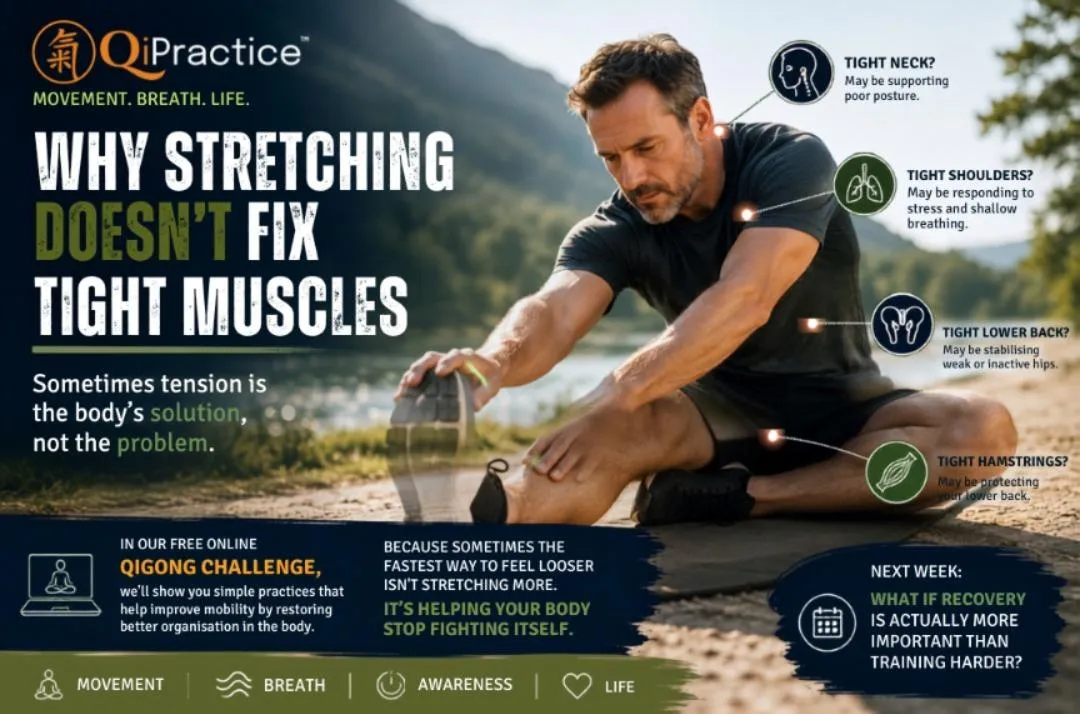
A tight neck may be helping support poor posture.
A tight lower back may be trying to stabilise weak or inactive hips.
Tight shoulders may be responding to stress, shallow breathing, or hours spent sitting at a desk.
In these situations, the tension isn't the problem.
It's the body's solution.
This is why stretching often provides temporary relief but rarely creates lasting change.
The body simply recreates the tension because it still believes that tension is necessary.
The real question isn't:
"How do I stretch this muscle?"
The real question is:
"Why is this muscle working so hard in the first place?"
This is where Qigong offers a different perspective.
Rather than fighting tension, Qigong helps restore organisation throughout the body.
Through posture, breathing, awareness, and gentle movement, the body gradually learns that it no longer needs to hold so much unnecessary tension.
The goal isn't to force muscles to relax.
The goal is to remove the reasons they need to stay tight.
When that happens, flexibility often improves naturally.
Not because you're stretching harder.
Because your body feels safe enough to let go.
Many students are surprised to discover that some of their biggest improvements in mobility come from learning how to stand, breathe, and move more efficiently.
When the body becomes more organised, movement becomes easier.
And tightness often starts taking care of itself.
In our Free Online Qigong Challenge, we'll show you simple practices that help improve mobility by reconnecting posture, breathing, and movement.
Because sometimes the fastest way to feel looser isn't stretching more.
It's helping your body stop fighting itself.
Next week we'll explore another surprising idea
What if recovery is actually more important than training harder?