Why Moving Harder Doesn't Mean Moving Better
Why Moving Harder Doesn't Mean Moving Better
We live in a culture that loves intensity.
Sweat more.
Push harder.
Move faster.
Do another rep.
And there's nothing inherently wrong with hard training.
The human body needs challenge.
But there's an important question we rarely ask:
How well are you moving while you're working hard?
Because more effort doesn't automatically create better movement.
Sometimes it simply makes your existing movement patterns louder.
Your Body Will Find a Way
Give your body a task and it will usually find some way to accomplish it.
That's one of the remarkable things about being human.
But the easiest solution isn't always the most efficient one.
Imagine lifting your arm overhead.
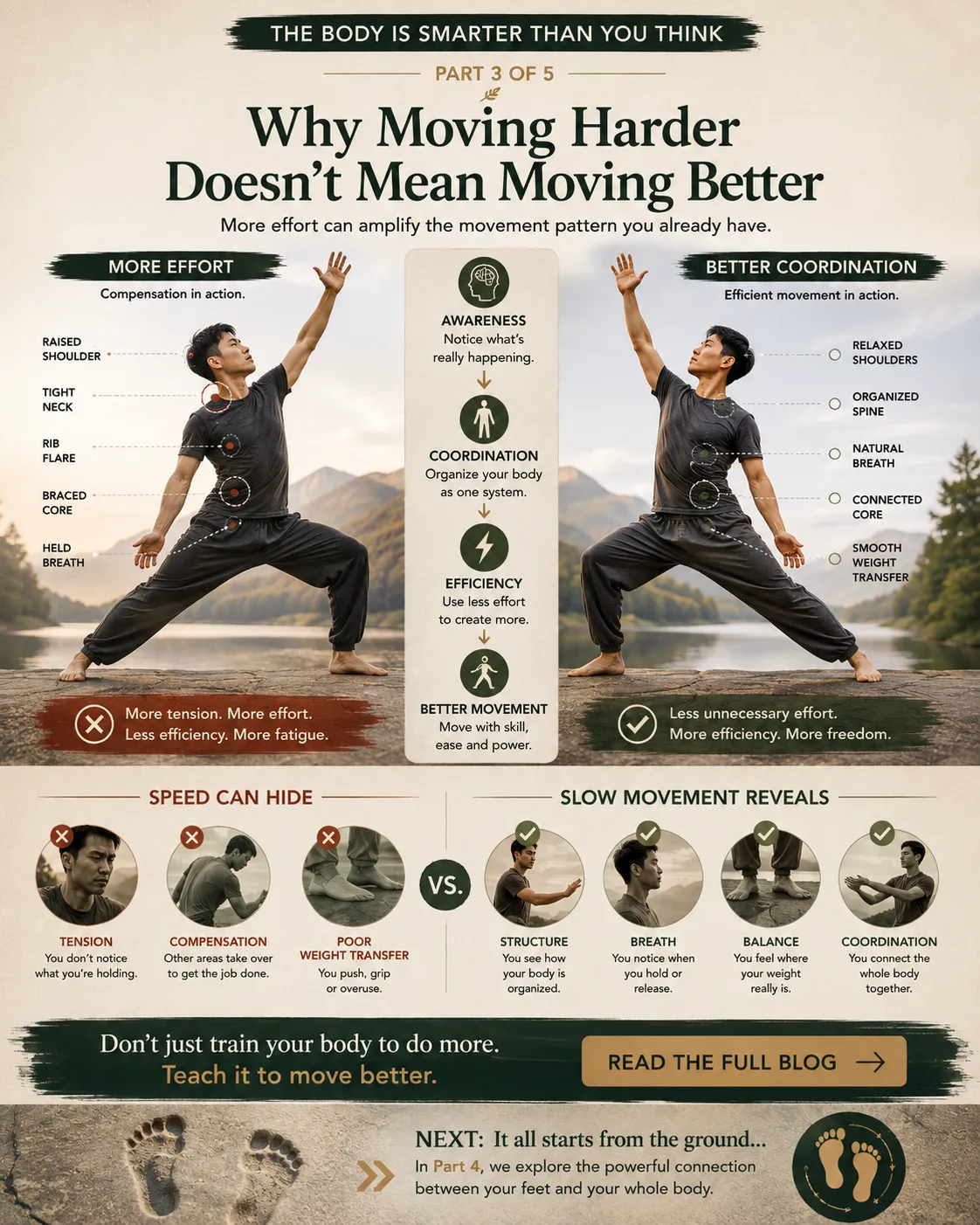
Ideally, the shoulder blade, ribs, spine, shoulder joint, and breath all coordinate.
But if that coordination isn't available, the body may compensate.
The shoulder rises.
The ribs flare.
The lower back arches.
The neck tightens.
Your arm still reaches overhead.
The mission was accomplished.
But the strategy wasn't particularly efficient.
Now add speed, resistance, or repetition.
You haven't necessarily improved the movement.
You've simply practiced the compensation harder.
Effort Can Hide Poor Coordination
Intensity has an interesting effect.
It can make us stop noticing.
When you're concentrating on completing another repetition, running faster, or pushing through fatigue, subtle details become harder to feel.
Where is the tension?
Are you holding your breath?
Are your shoulders helping with something they don't need to?
Are you moving from the hips or borrowing movement from the lower back?
The body can produce impressive amounts of effort while still being poorly organized.
Qigong reverses the equation.
Before asking:
How much can you do?
We first ask:
How well can you do it?
Slow Movement Is a Magnifying Glass
This is one reason Qigong often moves slowly.
Slow movement isn't easier movement.
Sometimes it's much more revealing.
When you remove momentum, you begin noticing things that speed can hide.
A weight shift becomes obvious.
A stiff hip becomes noticeable.
An unnecessary shoulder contraction suddenly appears.
You notice the exact moment you stop breathing.
Slow movement acts like a magnifying glass.
It gives your nervous system time to receive information, make adjustments, and explore a better solution.
Efficiency Is a Form of Strength
Think about someone learning to play a musical instrument.
A beginner often uses far too much effort.
The hands grip.
The shoulders tighten.
The face concentrates.
Everything participates.
An experienced musician can produce something extraordinary with far less visible effort.
They haven't become weaker.
They've become more coordinated.
Movement works the same way.
Skill reduces unnecessary effort.
And when unnecessary effort disappears, more of your available energy can actually contribute to the task.
This is one of the deeper meanings of relaxation in Qigong.
Relaxation isn't doing nothing.
It's removing what doesn't need to be there.
Move Better Before You Move More
This doesn't mean you should never train hard.
Quite the opposite.
A well-organized body has greater potential to express strength, speed, endurance, and power.
But intensity should be built on quality.
First establish the pattern.
Then challenge it.
Otherwise, you're simply adding horsepower to a car with poor steering.
Qigong gives us an environment where we can study movement before intensity overwhelms awareness.
Structure.
Breath.
Weight transfer.
Relaxation.
Coordination.
Awareness.
These aren't separate ideas.
They're different parts of the same movement system.
And when they begin working together, something interesting happens.
Movement often becomes easier while simultaneously becoming more powerful.
That's not magic.
That's efficiency.
Want to experience the difference?
Join our Free Online Qigong Challenge and explore what happens when you stop simply trying to move more and begin learning how to move better.
In Part 4, we're going all the way down to the ground.
Because one of the most overlooked parts of your movement system is sitting inside your shoes.
Your feet.