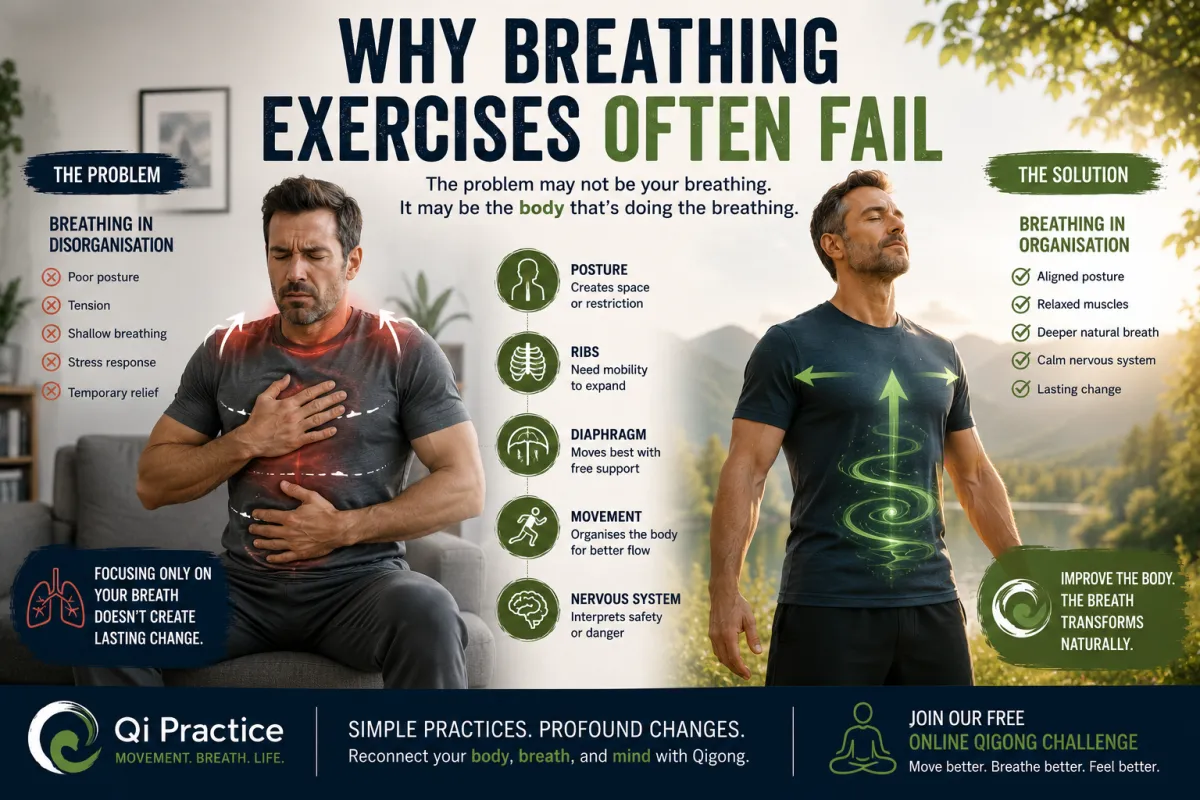
Why Breathing Exercises Often Fail (And What To Do Instead)

If you've ever tried a breathing exercise, you've probably experienced something like this.
You sit down.
Follow the instructions.
Take slower breaths.
Feel better for a few minutes.
Then an hour later, you're back to breathing exactly the same way you were before.
Sound familiar?
You're not alone.
Many people assume they have a breathing problem.
In reality, they often have a body organisation problem that's showing up through the breath.
The Missing Piece
Most breathing advice focuses on the breath itself.
Take deeper breaths.
Breathe into your belly.
Slow your breathing down.
While these techniques can be helpful, they often miss something important.
Breathing doesn't happen in isolation.
It happens through your body.
Your ribs move.
Your diaphragm moves.
Your spine moves.
Your posture influences how much space your lungs have available.
Your muscles influence how freely your body can expand and contract.
In other words, breathing is a whole-body activity.
If the body isn't working well, breathing often isn't either.
Why The Breath Keeps Returning To Old Habits
Imagine trying to open a door.
But the door frame is bent.
You can push harder.
But the real problem isn't the door.
It's the structure around it.
Breathing works in much the same way.
If your shoulders are constantly tense
If your ribs are stiff
If your posture is collapsed
If your nervous system feels stressed
Your body may struggle to breathe naturally.
This is why many breathing exercises provide temporary relief without creating lasting change.
The body simply returns to the pattern it knows best.
Not because the breathing exercise failed.
Because the conditions supporting healthy breathing haven't changed.
Breathing Is Information
Every breath sends information throughout the body.
Fast, shallow breathing often signals alertness.
Slow, natural breathing often supports recovery.
But breathing isn't just responding to the nervous system.
The nervous system is also responding to breathing.
The relationship works both ways.
That's why breathing has such a powerful influence on how we feel.
Change the breath and you influence the nervous system.
Change the nervous system and the breath often changes too.
A Different Approach
This is where Qigong takes a different approach.
Rather than focusing only on breathing techniques, Qigong works on the conditions that allow better breathing to emerge naturally.
Posture improves.
Movement improves.
Tension reduces.
Awareness increases.
The ribs become more mobile.
The body becomes more organised.
As these changes occur, breathing often begins changing by itself.
Many students are surprised to discover that they breathe better without spending all their time thinking about breathing.
The body simply becomes better at doing what it was designed to do.
The Goal Isn't Bigger Breaths
One of the biggest misconceptions about breathing is that more is always better.
Bigger breaths.
Deeper breaths.
More oxygen.
But healthy breathing isn't necessarily about breathing more.
It's often about breathing more efficiently.
The goal isn't to force the breath.
The goal is to remove the interference.
When the body becomes more organised, breathing often becomes easier.
When breathing becomes easier, the nervous system often becomes calmer.
And when the nervous system becomes calmer, everything from energy to recovery can begin improving too.
Experience The Difference
In our Free Online Qigong Challenge, you'll learn simple practices that help reconnect breathing, posture, movement, and relaxation.
Not by forcing the breath.
But by improving the conditions that allow natural breathing to happen.
Because sometimes the fastest way to improve your breathing isn't to focus on the breath.
It's to improve the body that's doing the breathing.
Join the Free Online Qigong Challenge Today
Next week we'll explore another common misunderstanding...
Can Qigong Improve Balance, Mobility and Flexibility?