What Your Feet Have to Do With Your Whole Body
What Your Feet Have to Do With Your Whole Body
Most people don't think much about their feet.
Until they hurt.
We put them inside shoes, walk around all day, and expect them to quietly carry us wherever we want to go.
But your feet aren't simply platforms underneath your body.
They're sensory organs.
They're shock absorbers.
They're part of your balance system.
And they're your physical relationship with the ground.
What happens at your feet can influence everything above them.
Your Body Builds From the Ground Up
Think about a building.
If the foundation shifts, everything above it has to respond.
Your body works in a similar way.
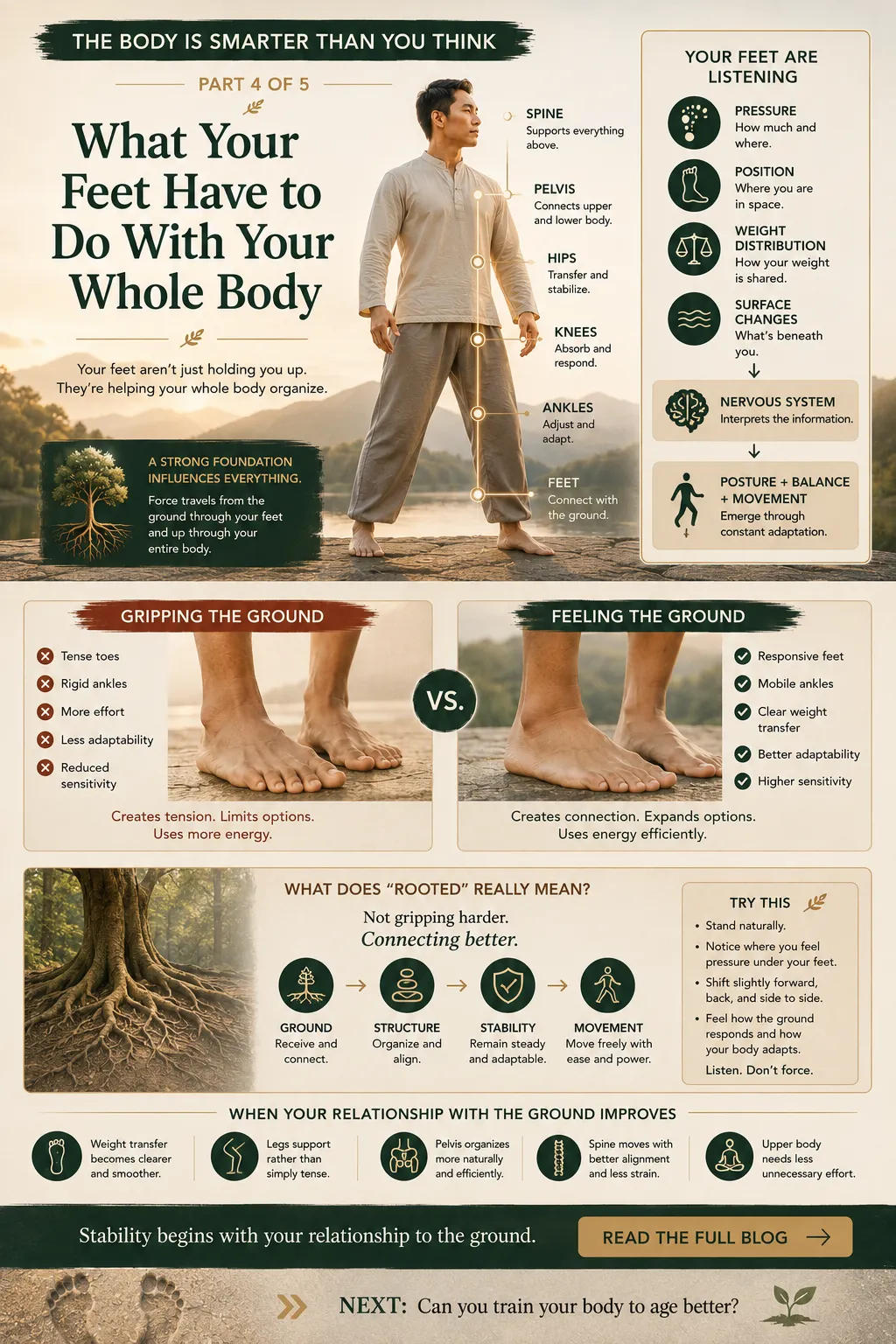
When you're standing, force travels between the ground and your body through your feet.
The feet influence the ankles.
The ankles influence the knees.
The knees influence the hips.
The hips influence the pelvis and spine.
This doesn't mean every knee, hip, or back problem comes from the feet.
Human bodies are far more complex than that.
But it does mean the feet participate in a much larger movement system.
They aren't separate from the rest of you.
Your Feet Are Constantly Sending Information
Your feet contain sensory receptors that help your nervous system understand pressure and position.
Where is your weight?
Forward?
Backward?
More on one side?
Are you standing on something stable?
Is the surface changing?
Your brain uses this information, alongside input from your joints, eyes, inner ear, and other sensory systems, to continuously organize your posture and movement.
Remember Part 2?
Balance is adaptation.
Your feet provide part of the information that makes that adaptation possible.
The Problem With Gripping the Ground
When people feel unstable, something interesting often happens.
Their toes grip.
Their arches stiffen.
Their legs tighten.
They're trying to create stability.
Remember Part 1?
The body often uses tension when it doesn't feel secure.
But gripping the ground isn't the same as connecting with it.
Imagine trying to balance while making two tight fists with your feet.
You've created effort but you've also reduced sensitivity and adaptability.
Qigong teaches something subtler.
Instead of gripping the ground, we learn to feel it.
What Does "Rooting" Actually Mean?
Traditional Qigong and Taijiquan often talk about being "rooted."
It can sound mystical.
But there is a very practical side to the idea.
Rooting begins with your relationship to gravity and the ground.
Can you feel where your weight is?
Can your feet receive pressure without unnecessary gripping?
Can your joints organize above that foundation?
Can you shift weight without losing your structure?
Can you remain relaxed while force travels through the body?
A tree doesn't grip the earth with tension.
Its roots create connection and support.
Your feet aren't literally roots, of course.
But the metaphor points toward something useful:
Stability comes from connection, not rigidity.
Try This
Stand comfortably.
Without looking down, notice where you feel pressure underneath your feet.
More in the heels?
More toward the toes?
More on the inside?
More on the outside?
Don't try to correct anything yet.
Just notice.
Now gently shift your weight a little forward and backward.
Feel how the pressure underneath your feet changes.
Then shift slightly from side to side.
Suddenly, standing isn't static anymore.
You're having a conversation with the ground.
That conversation is happening all day whether you're aware of it or not.
Qigong simply teaches you to listen.
From the Ground to the Whole Body
When your relationship with the ground improves, movement higher in the body can begin to change.
Weight transfer becomes clearer.
Balance becomes more responsive.
The legs can support rather than simply tense.
The pelvis can organize more naturally.
The upper body may need less unnecessary effort.
This is why Qigong pays so much attention to something as simple as standing.
Standing isn't doing nothing.
It's where we begin studying the entire body as one connected system.
Want to experience what "rooting" actually feels like?
Join our Free Online Qigong Challenge and explore how your feet, structure, breath, and movement connect from the ground up.
And in Part 5, we'll bring the entire series together around one question that eventually matters to all of us:
Can you actually train your body to age better?