The Missing Link Between Exercise and Recovery
Most people know how to train harder.
Few know how to recover better.
Modern culture celebrates effort.
Push harder.
Work longer.
Train more.
Stay busy.
We're often taught that more effort produces better results.
But the body doesn't quite work that way.
Here's something many people don't realise:
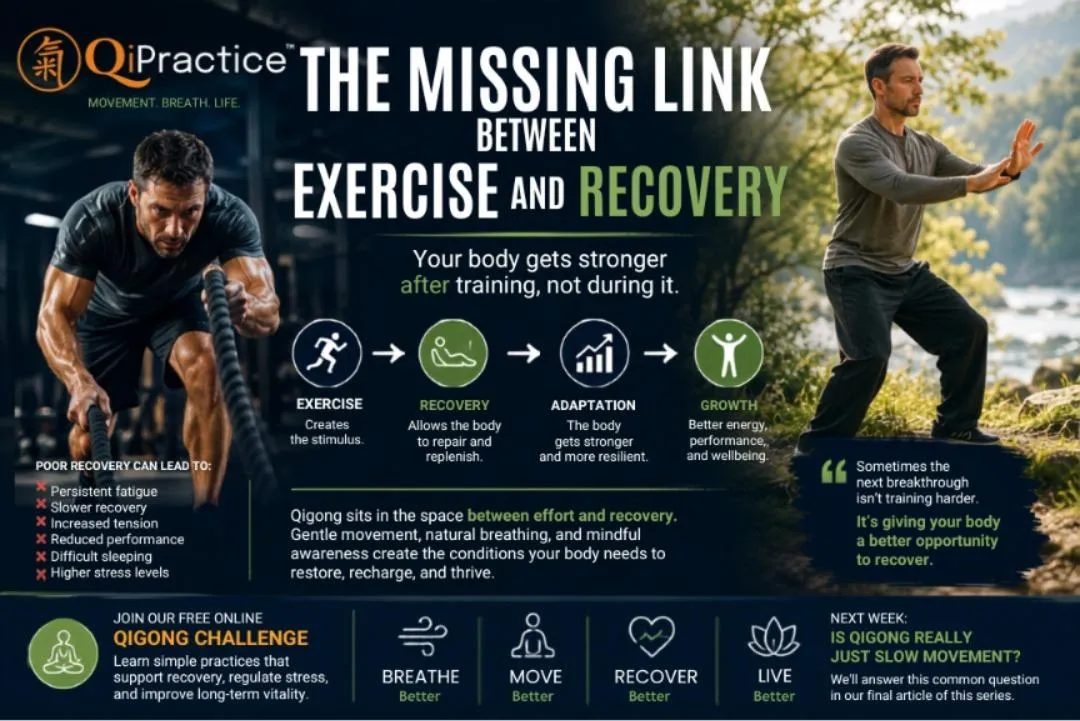
Your body doesn't get stronger during exercise.
It gets stronger after exercise.
Exercise creates a stimulus.
Recovery creates adaptation.
Without adequate recovery, the body never fully absorbs the benefits of the work you've done.
Instead, it remains in a constant state of trying to catch up.
Over time, this can contribute to:
• Persistent fatigue
• Slower recovery
• Increased tension
• Reduced performance
• Difficulty sleeping
• Higher stress levels
Think of exercise as making a withdrawal from your body's energy bank account.
Recovery is how you make deposits.
Both matter.
But many people spend far more time withdrawing than replenishing.
This is where Qigong offers a different perspective.
Qigong isn't simply exercise.
And it isn't simply relaxation.
It sits in the space between effort and recovery.
Gentle movement encourages circulation.
Natural breathing helps regulate the nervous system.
Awareness helps reduce unnecessary tension.
Together, these create the conditions that support recovery.
The goal isn't to do more.
The goal is to recover better.
Many students are surprised to discover that they often feel more energised after a Qigong session than before they started.
That's because Qigong isn't designed to exhaust the body.
It's designed to help restore it.
Athletes understand the importance of recovery.
Elite performers understand it.
Nature understands it.
Every cycle of growth contains a cycle of restoration.
The body is no different.
When recovery improves, energy often improves.
When energy improves, movement improves.
When movement improves, life becomes easier.
In our Free Online Qigong Challenge, you'll learn simple practices that help support recovery, regulate stress, and improve long-term vitality.
Because sometimes the next breakthrough isn't training harder.
It's giving your body a better opportunity to recover.
Next week we'll answer a question many people ask when they first discover Qigong
Is Qigong really just slow movement?