The Hidden Reason Your Posture Keeps Collapsing
Most posture advice sounds something like this:
"Pull your shoulders back."
"Sit up straight."
"Stand taller."
The problem?
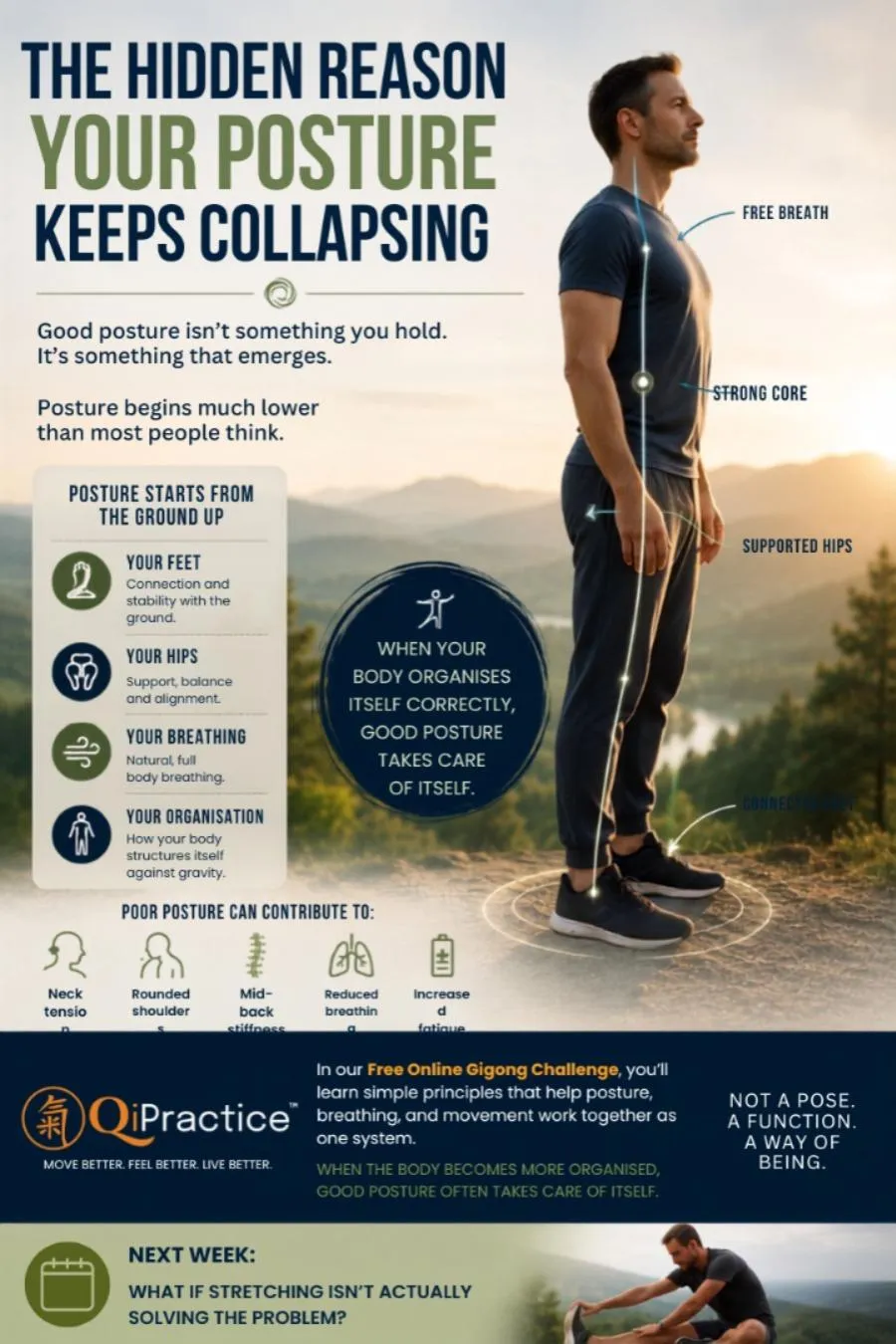
Good posture isn't something you hold.
It's something that emerges.
Think about building a house.
If the foundation shifts, the walls compensate.
If the walls compensate, the roof becomes unstable.
The human body works in much the same way.
Many people assume posture begins with the shoulders or upper back.
In reality, it begins much lower.
Your feet.
Your hips.
Your breathing.
And how your body organises itself against gravity.
This is why forcing yourself into a "good posture" position rarely lasts.
The moment you stop thinking about it, the body returns to its old habits.
Not because you're lazy.
Not because you lack discipline.
Because the structure underneath hasn't changed.
One of the biggest influences on posture is breathing.
When breathing becomes shallow and chest-dominant, the neck and shoulder muscles often start doing work they were never designed to do.
The ribs become less mobile.
The spine becomes less adaptable.
The body begins creating tension simply to stay upright.
Over time, this can contribute to:
• Neck tension
• Rounded shoulders
• Mid-back stiffness
• Reduced breathing capacity
• Increased fatigue
Many people try to solve these problems by forcing better posture.
But if the body isn't organised underneath, the correction rarely lasts.
This is where Qigong offers a different approach.
Rather than trying to hold the body in position, Qigong helps restore the conditions that allow good posture to emerge naturally.
When the feet connect.
When the hips support.
When the breath moves freely.
When unnecessary tension begins to soften.
The body often starts organising itself differently.
Good posture becomes less of a pose and more of a function.
The surprising result?
Many students discover that standing becomes easier.
Breathing becomes deeper.
Movement feels lighter.
Not because they're trying harder.
Because they're working with the body's natural design rather than against it.
In our Free Online Qigong Challenge, you'll learn simple principles that help posture, breathing, and movement work together as one system.
Because when the body becomes more organised, good posture often takes care of itself.
Next week we'll explore a common misunderstanding about tight muscles
What if stretching isn't actually solving the problem?