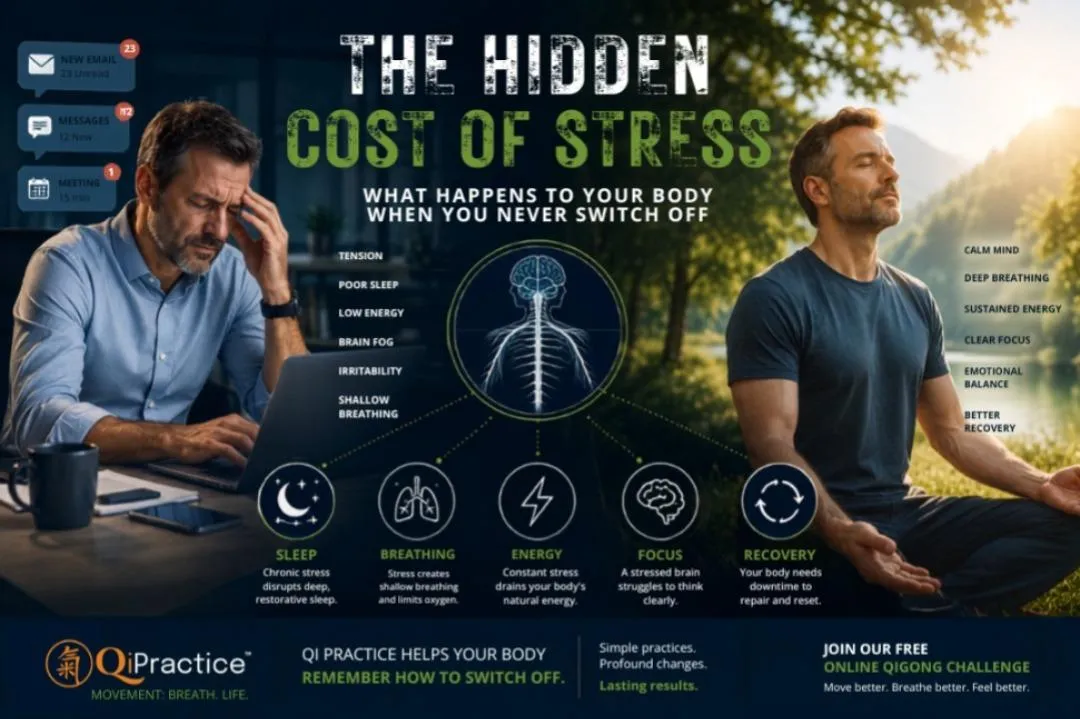
The Hidden Cost of Stress: What Happens to Your Body When You Never Switch Off
Stress has become so normal that many people no longer recognise it.
Being busy feels normal.
Feeling tired feels normal.
Sleeping poorly feels normal.
Having tight shoulders, a stiff neck, and a busy mind feels normal.
But normal doesn't always mean healthy.
The human body was designed to handle periods of stress.
It was never designed to remain stressed all day, every day.
Yet modern life often asks exactly that of us.
Emails.
Notifications.
Deadlines.
Traffic.
Financial pressures.
Family responsibilities.
Constant stimulation.
The result is that many people spend large parts of their day in a state of low-level survival mode without even realising it.
From the outside, everything may look fine.
But underneath the surface, the body is working much harder than it needs to.
The Body's Stress Response
When the brain perceives a challenge or threat, the body responds automatically.
Breathing becomes faster.
Muscles become more alert.
Heart rate increases.
Attention narrows.
Energy is directed toward immediate action.
This response is incredibly useful when you need it.
The problem arises when the body never fully switches it off.
Instead of moving between stress and recovery, many people become stuck somewhere in the middle.
Not in crisis.
But never truly relaxed.
Over time, this can affect how the body functions.
You may notice:
Persistent tension in the neck and shoulders
Difficulty relaxing
Poor sleep quality
Reduced energy
Brain fog
Increased irritability
Shallow breathing
A feeling of always being "on"
These are often not separate problems.
They're different expressions of the same underlying pattern.
Stress Changes The Way You Breathe
One of the first things stress influences is breathing.
When the body feels under pressure, breathing often becomes faster, shallower, and higher in the chest.
The neck and shoulder muscles begin assisting the breathing process.
The ribs become less mobile.
The diaphragm moves less efficiently.
The body gradually adapts to a pattern designed for survival rather than recovery.
Many people don't notice this happening because it develops slowly over time.
Eventually, stress breathing starts to feel normal.
But the body is still receiving the same message:
"Stay alert."
"Stay ready."
"Don't switch off."
The Ripple Effect
Breathing affects more than oxygen.
It influences posture.
Movement.
Energy.
Recovery.
And the nervous system itself.
When breathing becomes restricted, the body often creates additional tension to compensate.
Posture changes.
Movement becomes less efficient.
Recovery becomes more difficult.
The body begins spending energy managing tension instead of using that energy elsewhere.
This is why stress is rarely just a mental experience.
It's a whole-body experience.
A Different Approach
Most people try to manage stress by forcing relaxation.
They tell themselves to calm down.
Take a holiday.
Think positive thoughts.
While these things can help, they don't always address what's happening in the body.
Qigong approaches stress from a different direction.
Rather than fighting the mind, it works through posture, breathing, movement, and awareness.
As the body becomes more organised, breathing often becomes easier.
As breathing becomes easier, the nervous system receives a different message.
The body begins recognising that it is safe to let go of unnecessary tension.
The goal isn't to force relaxation.
The goal is to create the conditions where relaxation can happen naturally.
Health Is More Than The Absence Of Stress
Many people think health means having no symptoms.
No pain.
No stress.
No fatigue.
But true wellbeing is often about adaptability.
The ability to respond to life's challenges and then recover from them.
The ability to move between effort and relaxation.
Activity and rest.
Challenge and recovery.
When the body loses that flexibility, stress starts accumulating.
When the body regains that flexibility, resilience returns.
This is one of the reasons Qigong has been practised for centuries.
Not because life becomes stress-free.
But because the body becomes better at adapting to life's demands.
Experience It For Yourself
In our Free Online Qigong Challenge, you'll learn simple practices that help reconnect breathing, movement, posture, and relaxation.
You'll discover how small changes in the way you move and breathe can have a surprisingly large effect on how you feel.
Because sometimes the first step toward feeling better isn't doing more.
It's helping your body remember how to switch off.
Join the Free Online Qigong Challenge Today
Next week we'll explore a surprising idea
Why breathing exercises often fail and what to do instead.