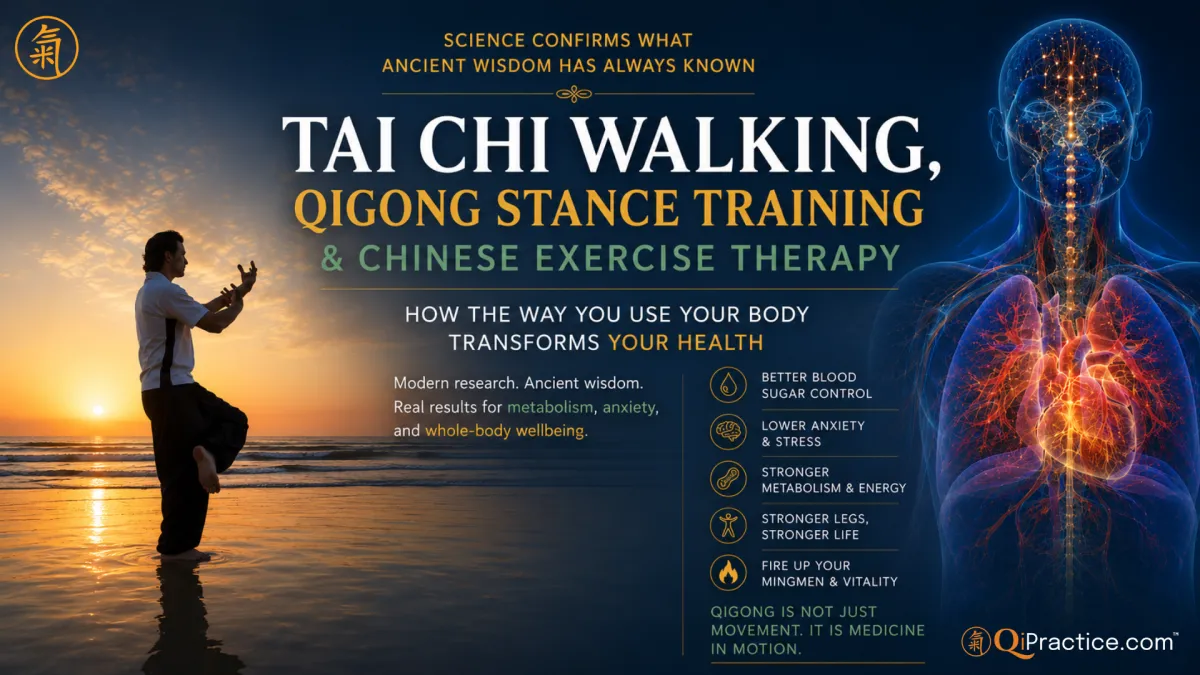
Metabolic Health and the Hidden Power of Qigong Stance Training
Can Qigong treat Diabetes?
A recent 2025 research paper titled “Effects of Health Qigong Walking Practice on Anxiety and Serum Metabolites in Patients with Type 2 Diabetes Mellitus” revealed something deeply important not just for diabetes management, but for understanding what Qigong and Chinese Exercise Therapy are actually doing inside the body.
The study found that Health Qigong Walking Practice significantly improved blood sugar regulation, reduced anxiety, improved triglycerides, and positively altered metabolic pathways linked to energy regulation and nervous system function and offers a promising adjunctive therapy for Type 2 Diabete.
And while the paper focused specifically on Tai Chi style Qigong walking
The deeper truth is this:
It is not merely the walking itself that creates the transformation.
It is the way the body is being used.
That distinction changes everything.
Qigong as Chinese Exercise Therapy
In the West, Qigong is often misunderstood as simply “slow movement” or “moving meditation.”
But traditionally, Qigong belongs to a much larger medical framework known as Chinese Exercise Therapy.
Within Classical Chinese Medicine, movement was never viewed as separate from medicine.
Historically, Chinese medicine developed through several interwoven therapeutic systems, including:
acupuncture and moxibustion
herbal and nutritional medicine
bonesetting, therapeutic massage, energy healing
and Qigong, Kung Fu and strength, health and wellness longevity arts often classified as Chinese Exercise Therapy
This is important because Chinese Exercise Therapy is not random exercise.
It is therapeutic movement specifically designed to regulate:
metabolism
circulation
breathing
nervous system function
organ health
posture
emotional regulation
and internal energy dynamics
In other words
The movements themselves are medicine.
This recent study helps validate that ancient principle through modern metabolomics, nervous system science, and exercise physiology.
The Real Medicine Was Never Just “Exercise”
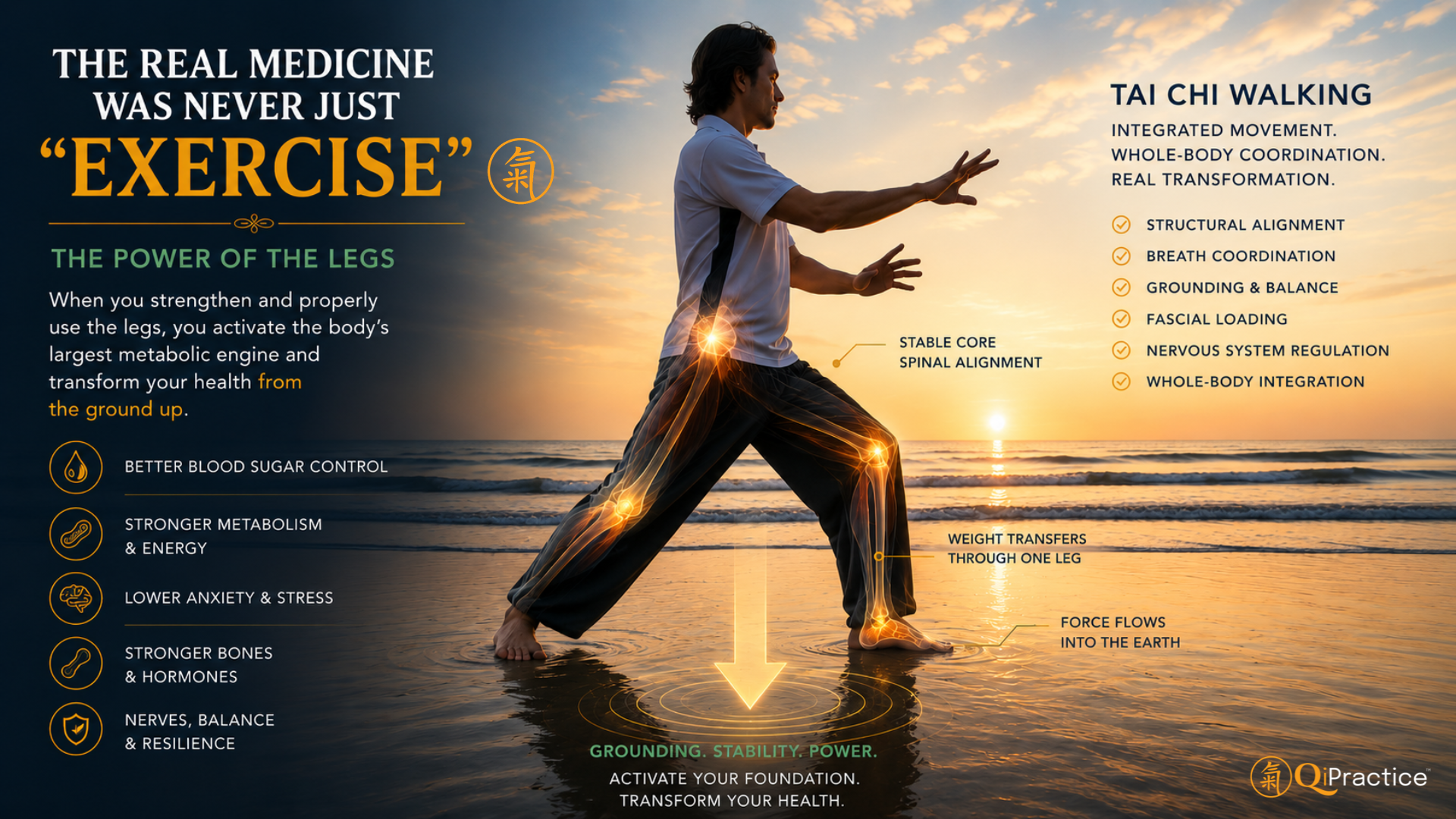
From a Western physiological perspective, one of the most powerful ways to improve metabolism is to strengthen and properly use the muscles of the legs.
Why?
Because the legs are the body’s largest metabolic engine.
When we strengthen and condition the legs correctly:
insulin sensitivity improves
glucose uptake increases
circulation improves
mitochondrial density increases
nervous system resilience improves
bone density increases
hormonal signalling improves
metabolic rate rises
Modern exercise science increasingly recognises lower-body training as one of the greatest regulators of metabolic health.
Chinese medicine understood this thousands of years ago through a different language.
The legs are our connection to the Earth.
And in Five Element theory, the Earth element governs transformation and transportation the body’s ability to transform food into usable energy.
That is metabolism.
So when this study demonstrated improvements in blood glucose, triglycerides, anxiety, and metabolic pathways through Health Qigong Walking Practice, what we are really seeing is the effect of integrated lower-body activation combined with breath, posture, nervous system regulation, and mindful movement.
This is Chinese Exercise Therapy in action.
Why Qigong Walking Works So Well
The paper found that Health Qigong Walking Practice outperformed standard aerobic walking in several metabolic markers, particularly postprandial blood glucose regulation.
That tells us something profound.
Both groups were walking
But only one group was walking with:
structural alignment
breath coordination
intentional posture
whole-body integration
mindful nervous system regulation
fascial loading through the legs and core
This is the essence of authentic Qigong and Chinese Exercise Therapy.
The body is not being used mechanically.
It is being used as an integrated living system.
In Qi Practice, we often describe this as moving in multiple dimensions simultaneously. Not simply forward and backward like conventional exercise, but through spirals, pressure shifts, breath dynamics, fascial tensioning, internal expansion, grounding forces, and whole-body coordination.
True Qigong movement is never merely muscular movement.
It is integrated movement.
The Human Body Is a Living Tensegrity System
Modern fascia research increasingly shows that the body does not function as isolated muscles pulling on separate bones.
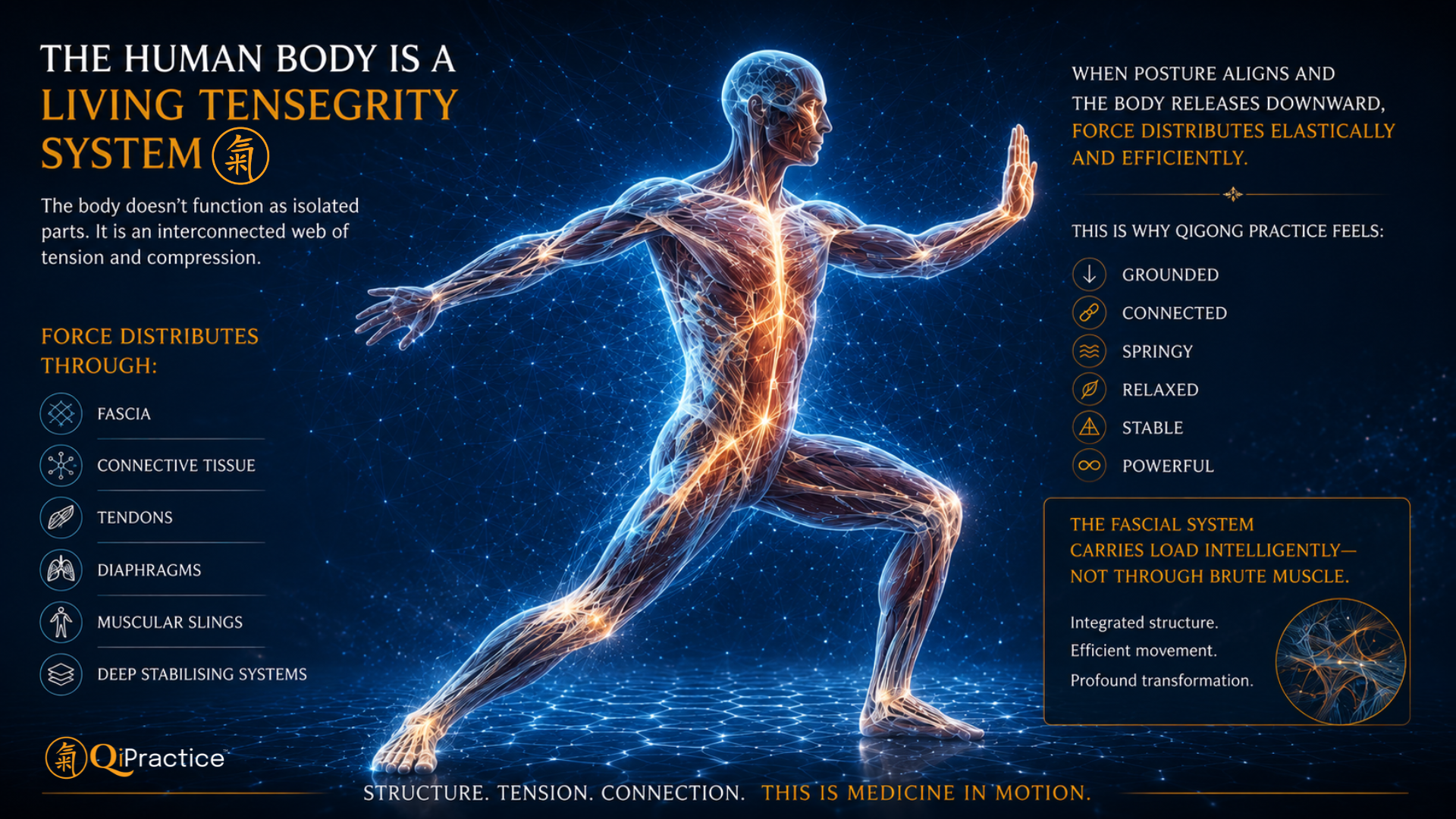
The body behaves more like a continuous web of tension and compression.
A tensegrity system.
Force distributes throughout the whole body through:
fascia
connective tissue
tendons
diaphragms
muscular slings
deep stabilising systems
Qigong practitioners have felt this directly for centuries.
When posture aligns correctly and the body releases downward into the Earth, force distributes through the system elastically and efficiently.
This is why proper Tai Chi walking or Zhan Zhuang standing can feel:
grounded
connected
springy
relaxed
stable
powerful
Not because of rigid muscular effort
But because the fascial system begins carrying load intelligently.
From the outside, Qigong can appear deceptively simple.
But internally, the practitioner is coordinating posture, breath, pressure, fascia, balance, nervous system regulation, intention, circulation, elasticity, and whole-body force transmission simultaneously.
This is why authentic Qigong and Chinese Exercise Therapy are far more sophisticated than they first appear.
The body is being trained dimensionally, not just mechanically.
The Deep Core Fascial Chain and Internal Fire
One of the most misunderstood aspects of Qigong and Chinese Exercise Therapy is the bent-leg stance.
From the outside, it appears simple.
Internally, however, something profound is happening.
In practices like:
horse stance
overtoe horse stance
Zhan Zhuang
Tai Chi walking
wide gait stance training
the legs soften and bend while the spine suspends upward.
Initially, most people hold themselves up through gross muscular contraction.
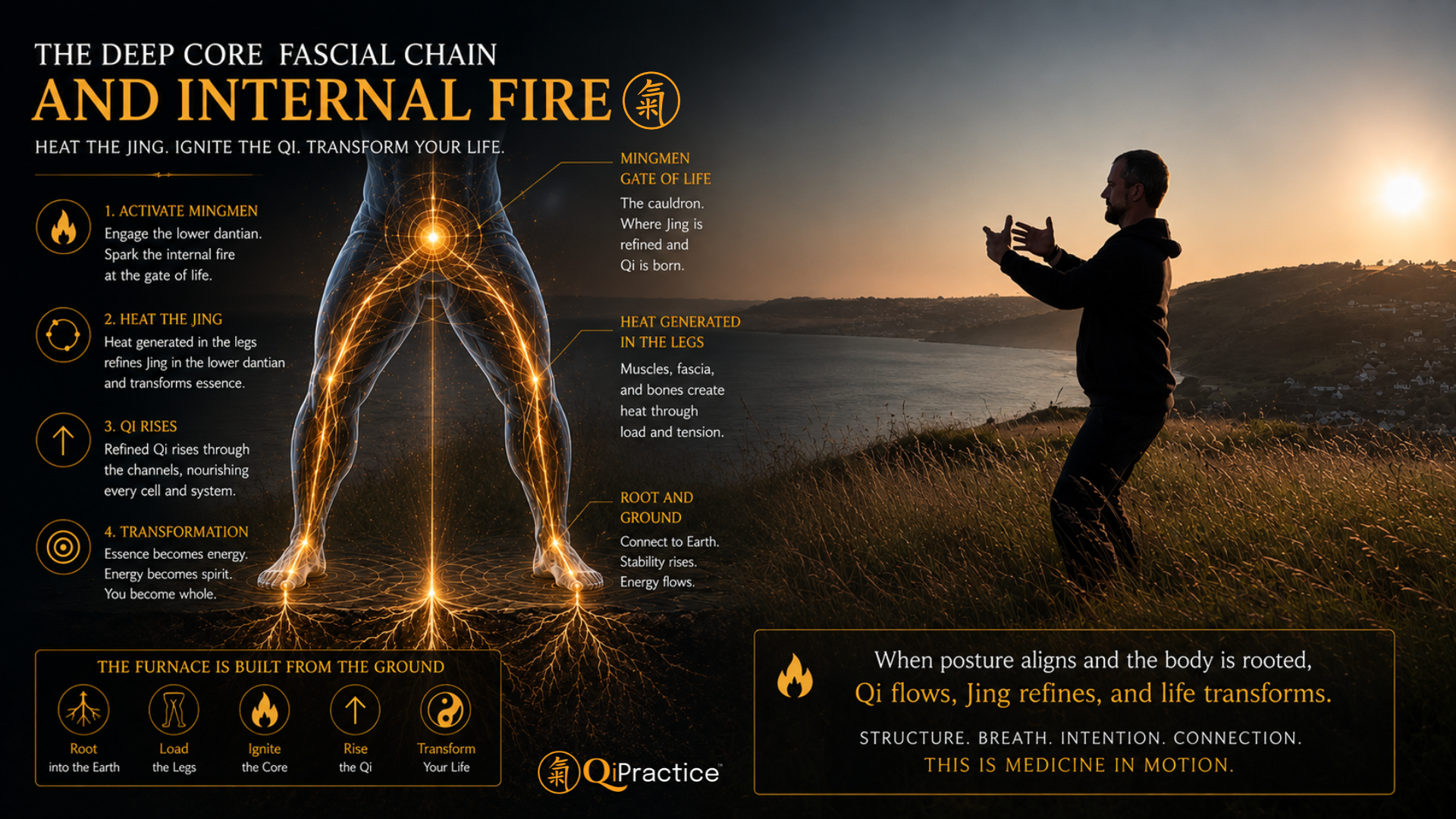
But over time, the body reorganises itself through the deep core fascial chain.
This deep internal line connects:
the arches of the feet
the inner legs
the pelvic floor
the psoas
the diaphragm
the lungs
the throat
and ultimately the tongue
This is one of the body’s deepest stabilising and energetic pathways.
In Daoist language, this relates to vertical integration and internal power development.
In modern anatomy, this reflects whole-body fascial integration and mechanotransduction.
Within the Qi Transformation System, these principles are progressively trained through stance work, grounding mechanics, breath regulation, and internal movement development allowing the body to evolve from gross muscular effort toward integrated elastic power.
Mechanotransduction How Structure Changes Biology
Mechanotransduction is the process whereby mechanical tension changes cellular behaviour.
In simple language:
How you load your body changes your biology.
When you stand correctly in Qigong:
fascia remodels
muscles strengthen
bone density improves
circulation increases
nervous system regulation improves
cellular signalling changes
mitochondrial efficiency improves
The body literally adapts to the forces transmitted through it.
This is why Chinese Exercise Therapy should not be mistaken for “gentle exercise.”
It is structured biological communication.
The body is being taught how to organise itself more efficiently.
This is one reason Qigong sits within what we call the Human Performance Continuum.
At first, people begin by learning posture and movement.
Then they begin regulating breath.
Then the nervous system settles.
Then force transmits more efficiently through the fascia.
Eventually the body starts behaving less like disconnected parts and more like one coordinated system.
This is where movement stops being exercise alone and starts becoming embodied self-regulation.
Mingmen Fire and Metabolism
In Chinese Medicine, the Mingmen the “Gate of Life” is associated with foundational vitality and metabolic fire.
Interestingly, many Qigong systems place enormous emphasis on:
bent knees
soft kua
lower abdominal activation
grounding through the legs
warming the lumbar region
activating the lower Dantian
Why?
Because these postures mechanically and energetically stimulate the body’s deep metabolic engine.
The overtoe horse stance in the Qi Transformation System is a perfect example.
As the legs bend and the body settles downward:
the lower body becomes loaded
blood flow increases
metabolic demand rises
connective tissues become activated
deep stabilisers awaken
the core pressure system engages
Over time, this generates profound internal heat.
Not surface tension.
Internal metabolic fire.
This is Mingmen.
And from a Western perspective, this makes remarkable physiological sense.
You are effectively training a sustained isometric squat integrated with diaphragmatic breathing, fascial loading, nervous system regulation, and whole-body structural alignment.
That combination is extraordinarily powerful for metabolic health.
The Secret Was Never “Movement Quantity”
Modern fitness culture often focuses on:
more reps
more intensity
more steps
more calories burned
Qigong and Chinese Exercise Therapy ask a different question:
How are you using your body?
Because the body responds not merely to movement
But to the quality of movement.
Tai Chi walking works because there are moments where the entire body weight transfers through one leg while maintaining structural integrity, breath regulation, and grounded alignment.
This creates:
fascial loading
neurological integration
balance refinement
stabiliser activation
deep muscular recruitment
metabolic demand
But these same principles exist in virtually every authentic Qigong stance.
Standing correctly in Zhan Zhuang with softened legs and suspended posture may appear externally still
Yet internally the body is alive with:
postural adaptation
connective tissue tensioning
nervous system refinement
breath integration
metabolic activation
Stillness is not inactivity.
Stillness is organised potential.
In Qigong, this is sometimes referred to as internal movement.
Externally the body may appear still
Yet internally there is constant adaptation occurring through the breath, fascia, nervous system, balance systems, circulation, and deep stabilising chains of the body.
The body is quietly reorganising itself from the inside out.
Qigong, Chinese Exercise Therapy, and the Future of Metabolic Health
This research validates something traditional Chinese Exercise Therapy systems have understood for centuries:
The body heals best when movement, breath, posture, awareness, and internal regulation function together as one integrated system.
Not fragmented.
Integrated.
The future of health is not simply harder exercise.
It is intelligent exercise.
Exercise that:
regulates the nervous system
builds structural integrity
strengthens fascia
improves metabolic flexibility
restores grounding
develops internal coordination
harmonises mind and body
This is also why authentic Qigong has always been a path of self-mastery.
Because when we learn to regulate posture, breathing, attention, grounding, tension, emotional state, and nervous system activation
We are no longer simply exercising the body.
We are training the entire human system.
This is why Qigong remains one of the most sophisticated systems of Chinese Exercise Therapy ever developed.
The walking matters.
But the principles matter more.
Because when posture, breath, fascia, nervous system, and intention align correctly
Even standing still becomes medicine.
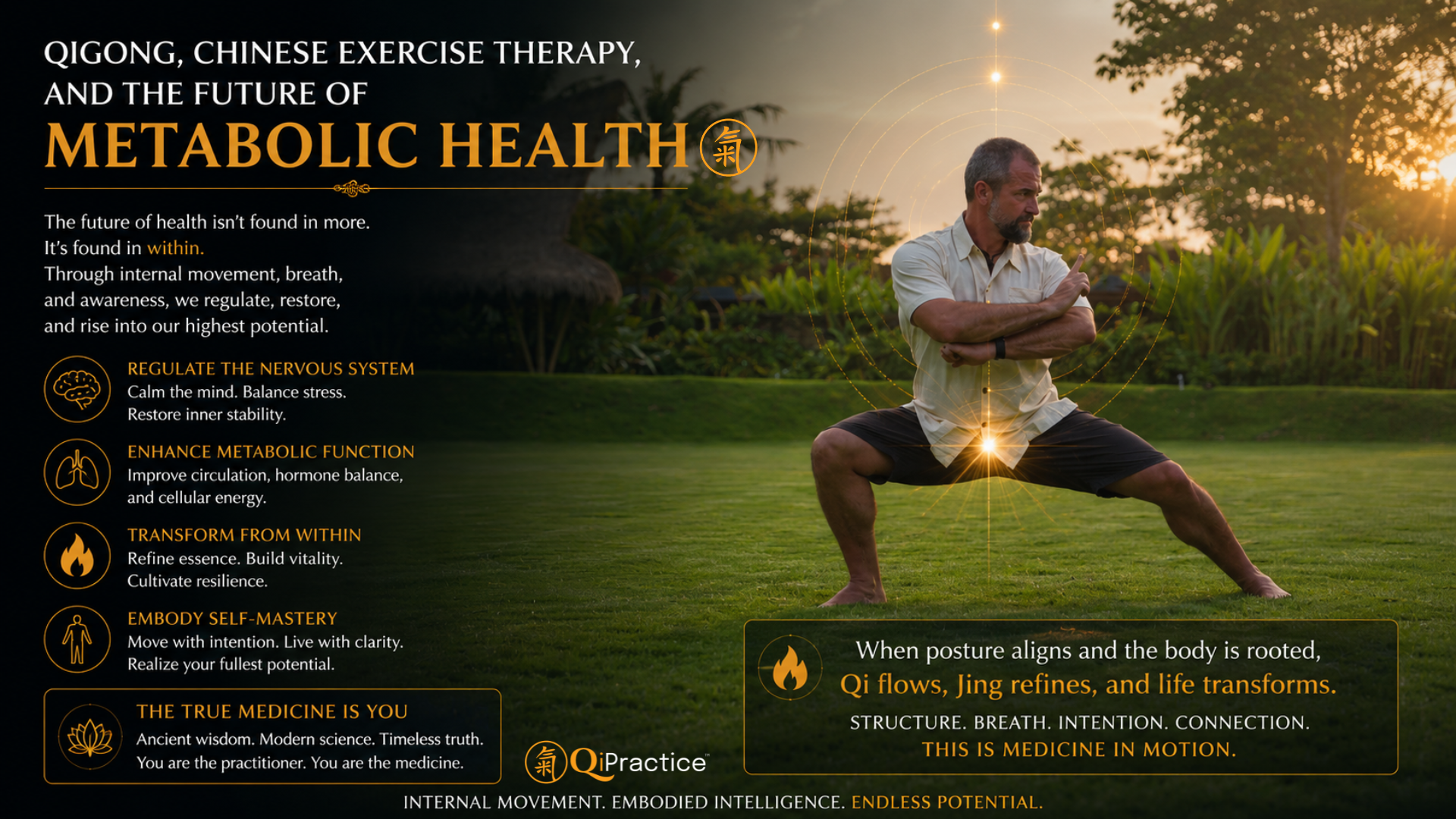
Discover the Deeper Science of Qigong and Chinese Exercise Therapy
As modern research continues validating the metabolic, neurological, and physiological benefits of Qigong, we are beginning to see something the ancient traditions understood long ago
The body heals best when structure, breath, movement, awareness, and internal regulation work together as one integrated system.
At Qi Practice, we teach Qigong not simply as relaxation or exercise, but as a sophisticated system of Chinese Exercise Therapy one that develops posture, fascia, breathing, nervous system regulation, internal power, and self-mastery from the inside out.
If you’d like to experience these principles for yourself and learn more about:
the biomedical science behind Qigong
fascia, tensegrity, and mechanotransduction
how Qigong improves metabolism and nervous system health
why stance training changes the body so profoundly
and how internal movement develops true embodied strength and resilience
We’d love to invite you to join our upcoming Free 5-Day Qigong Challenge.
This immersive experience is designed to help you feel the principles directly in your own body through guided daily training and practical embodiment exercises.
👉 Register here for the next Free 5-Day Qigong Challenge: