Can You Actually Train Your Body to Age Better?
Can You Actually Train Your Body to Age Better?
Aging is inevitable.
But becoming increasingly disconnected from your body doesn't have to be.
We often talk about aging as though it's something that simply happens to us.
We get older.
We become stiffer.
Balance declines.
Movement becomes harder.
Energy disappears.
And eventually, we assume we should simply accept it.
But there is another way to look at aging.
Your body is constantly adapting to what you ask it to do.
The question is:
What are you training it to become?
Your Body Adapts Throughout Life
The human body is remarkably adaptable.
Muscles respond to use.
Balance responds to practice.
Movement responds to repetition.
The nervous system continues learning.
And the way you move today influences the options available to you tomorrow.
This doesn't mean Qigong stops biological aging.
Nothing does.
But there is an enormous difference between getting older and gradually losing the physical skills that help us move through life well.
Strength Matters, But So Does Coordination
Healthy aging isn't simply about maintaining muscle.
Strength is important.
But strength without balance, mobility, coordination, and body awareness doesn't give us the whole picture.
Think about something as simple as stepping off a curb.
Your body has to:
See the change in height.
Shift your weight.
Balance on one leg.
Coordinate the other leg.
Absorb force.
Reorganize your posture.
Then continue walking.
You don't consciously calculate any of this.
Your nervous system handles it.
This is why movement quality matters.
We're not simply training muscles.
We're training relationships.
Balance Is a Skill
Remember Part 2?
Balance isn't standing perfectly still.
It's adapting to change.
As we age, this becomes increasingly valuable.
Can you shift your weight comfortably?
Can you recover when something unexpected happens?
Can your feet sense the ground?
Can your joints adapt?
Can your body find center again?
These are skills.
And skills can be practiced.
Mobility Is More Than Flexibility
Being able to stretch a muscle doesn't automatically mean you can use that range of motion effectively.
Useful mobility requires control.
Your nervous system needs to feel comfortable allowing movement.
Your joints need options.
Your muscles need to coordinate.
Your structure needs to adapt.
This is why Qigong combines gentle mobility with awareness, weight transfer, breathing, and postural organization.
We're not simply trying to become more flexible.
We're trying to remain capable.
Your Nervous System Needs Practice Too
One of the most overlooked aspects of healthy aging is learning.
Whenever you practice a movement with attention, your brain receives information.
Where am I?
Where is my weight?
How much tension am I using?
Can I move differently?
Can I make this easier?
Qigong turns simple movements into opportunities for this kind of sensory learning.
Slowly.
Deliberately.
Without needing to exhaust the body.
The Goal Isn't to Stay Young
This is important.
Qigong isn't about pretending we're 25 forever.
Aging is part of nature.
Daoist philosophy never asked us to fight nature.
It asked us to understand it.
A tree changes with every season.
But a healthy tree remains responsive.
Flexible enough to move.
Strong enough to stand.
Rooted enough to remain stable.
That's a useful way to think about our bodies too.
The goal isn't eternal youth.
The goal is capacity.
To keep moving.
To keep adapting.
To keep breathing well.
To keep trusting your body.
To keep participating in life.
Five Lessons, One Body
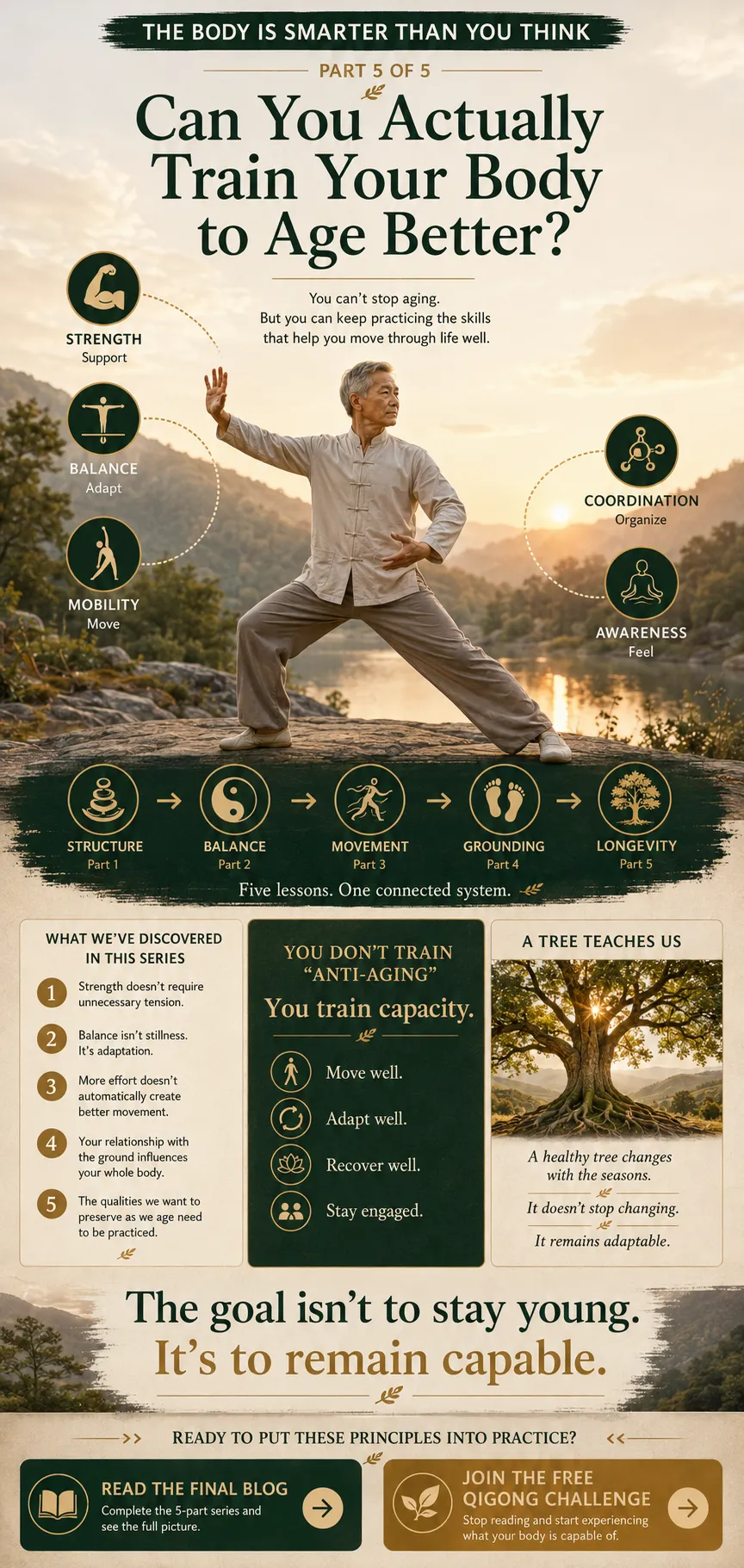
Throughout The Body Is Smarter Than You Think, we've explored five ideas:
1. Strength doesn't require unnecessary tension.
2. Balance isn't stillness. It's adaptation.
3. More effort doesn't automatically create better movement.
4. Your relationship with the ground influences your whole body.
And finally
5. The qualities we want to preserve as we age need to be practiced.
This is where Qigong becomes much more than a collection of slow exercises.
It's a way of continually practicing the fundamental skills of being human.
Standing.
Breathing.
Balancing.
Moving.
Feeling.
Adapting.
Relaxing.
And coordinating the whole system.
You don't need to wait until movement becomes difficult to start practicing these skills.
You can begin now.
And the best way to understand Qigong isn't to keep reading about it.
It's to feel it.
🌿 Join our Free Online Qigong Challenge and experience what your body is capable of when you begin working with it rather than simply pushing it.
Your body is smarter than you think.
Sometimes, we simply need to learn how to listen.