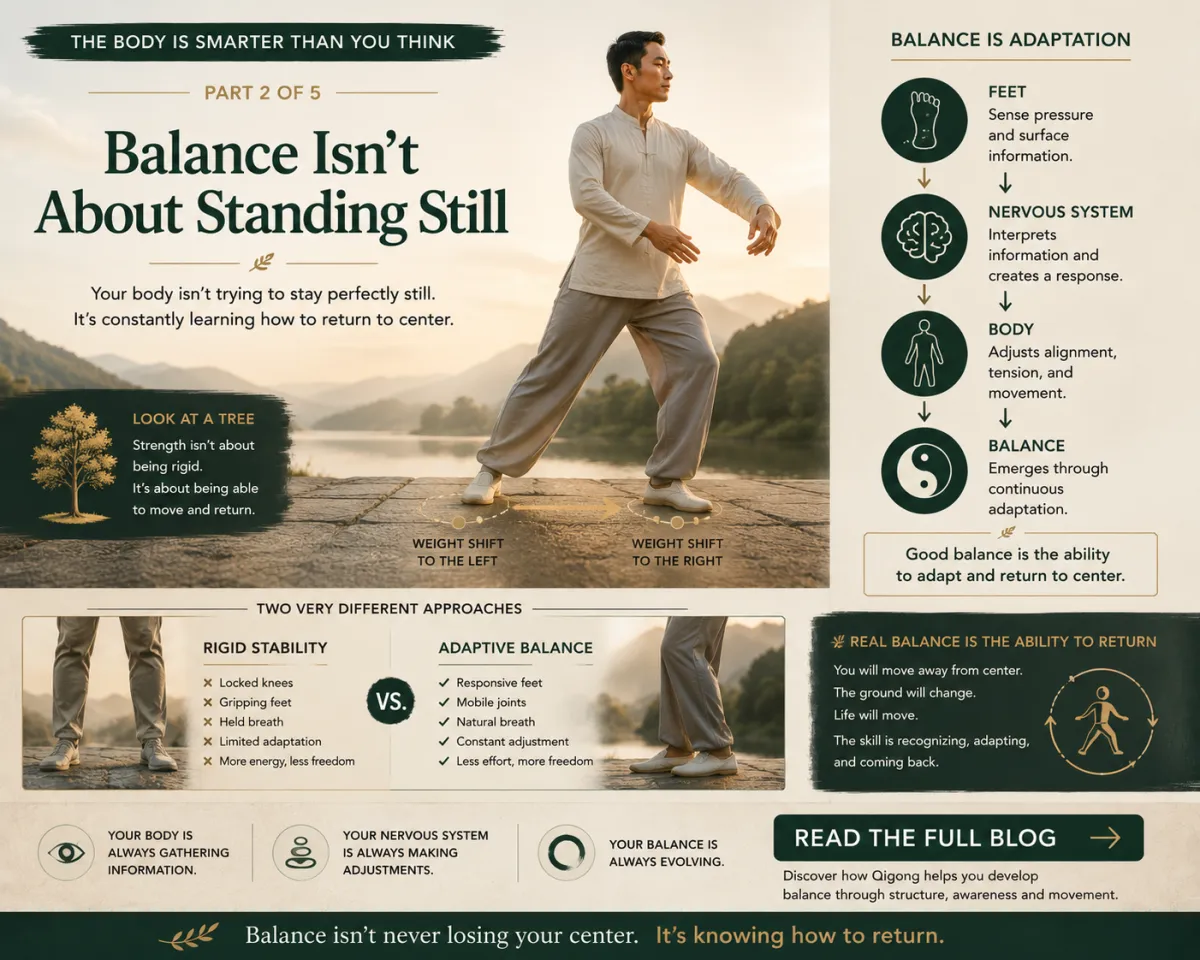
Balance Isn't About Standing Still
Balance Isn't About Standing Still
When most people think about good balance, they imagine someone standing perfectly still on one leg.
No wobbling.
No movement.
No loss of control.
But here's the interesting part, your body is never truly still.
Even when you're quietly standing, your nervous system is constantly making tiny adjustments.
Your ankles respond.
Your feet change pressure.
Your hips shift.
Your eyes gather information.
Your inner ear senses orientation.
Your brain continuously integrates these signals and adjusts your muscles accordingly.
Balance isn't stillness.
Balance is adaptation.
Your Body Is Constantly Negotiating With Gravity
Imagine a tree in the wind.
A rigid tree doesn't necessarily have better balance.
In fact, too much rigidity makes it more vulnerable.
A healthy tree moves.
It bends.
It responds.
Then it returns toward center.
The human body works in a surprisingly similar way.
Good balance requires enough structure to support you and enough freedom to adapt.
Why Tension Can Make Balance Worse
When people feel unstable, they often tense their entire body.
The knees stiffen.
The toes grip.
The shoulders rise.
The breath becomes shallow.
This may temporarily create a feeling of control.
But excessive rigidity can actually reduce your ability to respond to change.
Remember Part 1?
The body sometimes uses tension when it doesn't trust its structure.
Balance reveals the same principle.
If everything is locked, the body has fewer options.
Your Feet Are Listening
Your feet contain an extraordinary amount of sensory information.
Every moment you're standing, they are communicating with your nervous system about pressure, position, and the surface beneath you.
That information contributes to proprioception, your body's ability to sense where it is in space.
But balance isn't created by the feet alone.
The ankles, knees, hips, spine, eyes, vestibular system, and nervous system all participate.
Balance is a whole-body conversation.
This Is Why Qigong Moves Slowly
Many Qigong movements involve gentle weight shifting.
Forward.
Backward.
Left.
Right.
At first, this may look almost too simple.
But beneath the surface, your nervous system is learning.
Where is my weight?
Where is my center?
How much tension do I actually need?
Can I move without losing my structure?
Can I remain relaxed while my balance changes?
Slow movement gives the nervous system time to notice these relationships.
Balance Is the Ability to Return
Real balance doesn't mean never losing your center.
Life doesn't work that way.
The ground changes.
People bump into us.
We trip.
We turn quickly.
We age.
The real skill is recognizing change and responding appropriately.
You move away from center then find your way back.
This principle reaches far beyond physical balance.
It is one of the deeper lessons hidden inside Qigong.
Don't become rigid trying to remain centered.
Learn how to return.
Want to experience these principles rather than simply understand them intellectually?
Join our Free Online Qigong Challenge and discover how Qigong develops balance through structure, awareness, relaxation, and movement.
And in Part 3, we'll challenge another modern fitness assumption:
Does moving harder actually mean you're moving better?